The Art of Make Believe
by Vittorio Canta
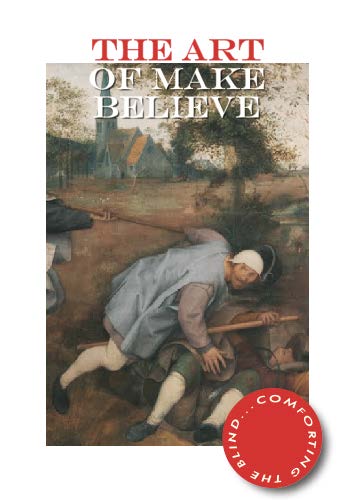
VITTORIO CANTA © 2022
2
PREAMBLE
Before engaging on this short journey, let us look at an old painting which allegory summarizes the essence of this presentation.
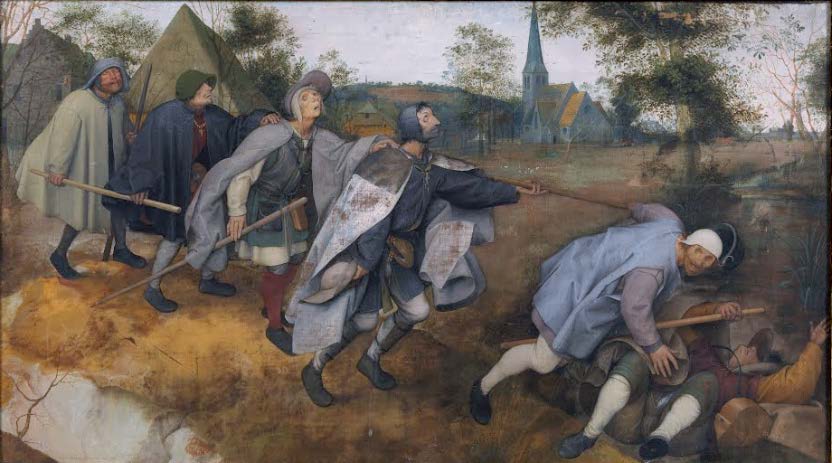
THE BLIND LEADING THE BLIND
Perhaps the most famous depiction of the phrase is Pieter Bruegel’s The Blind Leading the Blind. Completed in 1568, the distemper on canvas Is currently in the collection of the Museo di Capodimonte in Naples, Italy.
Amongst different interpretations, it’s possible that the author alluded to how certain institutions can hinder our capacity to see what we should.
While clarifying that the following considerations are not intended to change the course of history, the ideas here explored may be worth reflecting upon before making your own deductions.
3
The subject is art and its intellectual significance as perceived by the general public.
Therefore, it would be essential to give a realistic dimension to this three letter word by reviewing the etymology for art.
ITS ETYMOLOGY
[According to available literature, the word art derives from a suffixed form of root *ar-, “to fit together.” The same root of Latin arma “weapons”. “In Sanskrit, “manner, mode;” in Greek, artizein, “to prepare”.
Art is defined as a skill resulting from learning or practice.” In Middle English it suggests “skill in scholarship and learning”. From late 15c., art is understood as a “system of rules and traditions for performing certain actions”. Also, a sense of “skill in cunning and trickery”. In late 16c., early 17c., “the sense of artful, artless, artisans”. “Skill in
4
creative arts”, used especially for painting, sculpture, music, etc.]
Whatever we can retain from these multiple definitions, it is clear that art does not happen by accident.
As per all human achievements, discipline and dedication are essential in creating masterpieces and my argument is founded on the premise that we must distinguish the gifted authors from the impostors.
Specifically, we are talking about “The art of make believe”, a concept that can be extended to religion, politics, and other aspects of life.
In order to put things into perspective, it is essential to understand that the word ‘artist’ was not in our lexicon until a century ago.
Maestro, Master, Maître, Meister, Meester were used to address artisans at work. Their talent gave them a title and a dimension and their work was appreciated and remunerated accordingly. Later, that same root brought us the commonly used ‘mister’ to honorifically address males of higher social rank.
5
What is now a convention, once indicated those with some superior attributes.
Artisans’ hands carved stone, wood and forged metal. It was when shoehorns were made from the horns of cows. The trades were many and the visual arts were a part of them.
From the Paleolithic period onwards, the gifted brought us unique representations of the past. Comprehensible images incapsulated events, myths and ideas allowing us to close the gap between ages and understand the reasons for which those creations were made.
So it was until silver nitrate mechanical devices replaced the hands of skillful artisans and put their role in doubt.
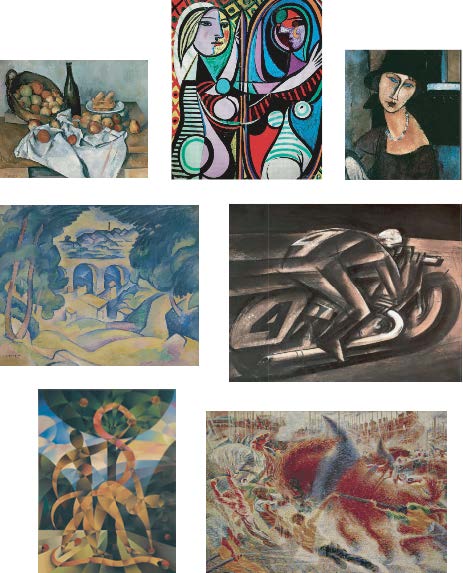
Notwithstanding, over a century ago avant-garde expressionists showed us what can be done when escaping realism and gave us images that made us ponder about their significance.
It was still up to us to decide which composition inspired us the most.
6
7
Without being indoctrinated, the public was able to follow the path of variable stylistic interpretations.
When content was no longer the issue, form alone bewildered the educated audience.
Until the early 1920’s, while kings and queens still had their portraits made by the last of formal painters, a form of pseudo-intellectualism (known as Dadaism) provided the next platform for the impressionists and the surrealists running out of stylistic alternatives.
The pseudo-intellectual aspect of dadaism was a reactionary movement of those elitists who did not want to be associated with the lower class. Coincidently, a correlated phenomenon invaded the upper class when spiritualism surged all over with mediums claiming to communicate with the afterlife.
While talented artisans were left on the sideline, the art movement took a turn when the word ‘artist’ began defining those who make art. Then, art no longer made the artist but vice-versa.
8
It was the era of magicians who mesmerized the public with impressive tricks. It was when a drinkable liquid consisting of artificially coloured sparking water (Coke) flooded the market. Progressively, the display of gratuitous fantasies became the fertile grounds for swindlers supported by pseudo intellectuals.
It was when shrewd art critics in search of notoriety flourished.
Since the idea of novelty always provides a sense of worth for any product, the new and the unusual drove the game forward.
Obviously, the financial aspect became the only catalyst in determining the value of whatever was proposed by critics.
It was the end of cognitive art.
9
INTERIM
At this point it is essential to elaborate on the meaning of COGNITIVE.
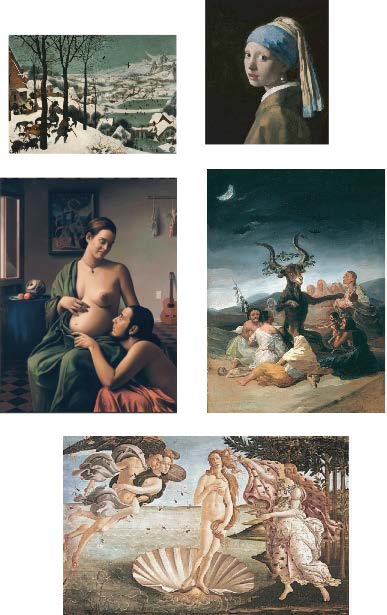
When interaction between the average viewer and artistic representations takes place through a comprehensive vocabulary, each individual perception is shared by all through common aesthetic canons.
If less educated viewers will only comprehend what their subconscious suggests, the creativity of the authors has no ambiguity in enriching our knowledge, our culture or our state of consciousness.
Amongst Bruegel, Vermeer, Vita Di Milano, Goya or Botticelli, you may decide which one inspires you the most.
10
11
However, if cognitive art educates our mind, the art of ENTERTAINMENT has removed any coherent aspect when crowds line up through metal gates in Central Park*, or follow a mob walking on Styrofoam’s pontoons floating over the Iseo Lake*. (*Christo)
While we can appreciate the participatory aspect, admiring the skill of your favoured player at a soccer game or your hockey idol, may offer a more compelling experience.
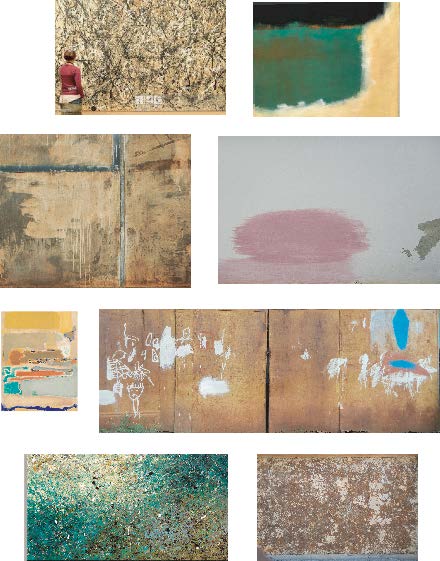
By the way, since we are talking about games, and if participation consists of understanding art through our personal perception, please take a close look at a series of abstract paintings and estimate their appraised value.
For any keen observer the challenge consists in distinguishing walls and doors in a poor Caribbean village from what is currently hanging on the walls of museums and galleries.
12
13
About abstractions, let us not omit Mr. DaVinci’s quotation when asked what was the highest form of art. His reply: “Humidity stains on walls of buildings”.
His point was rather simple and somehow sarcastic because those with the capacity to see rampant horses or flaming dragons amongst stains have the unique ability to perceive what others may not. It’s the attribute of each individual mind in search of a vision not suggested by anyone else.
A further understanding of this observation can be found in the Rorschach test.
Based on the interpretation of images suggested by casual splatters, it affirms how our mind is constantly searching for a reality that differs with each individual.
14
BACK TO ABSTRACTIONS.
Since art critics took charge of the game, the ability to turn stains into illusionary masterpieces has become the art of make believe.
A banana taped to a wall, an auctioned drawing shredded through a frame or invisible statues sold to real collectors – all perceived as ‘art’.
Now, not only the critic, but the media is sufficient in certifying the name of an artist.
Explaining why the public and the market accept paying tribute to absurdities it’s a complex issue that brings us back to our education (or lack of it) when, in the early years of life, charlatans tell us of things that do not exist.
Introducing Monalisa Mustache, a 1947 book by Robsjohn-Gibbings, Frank K. Kelly wrote: [“We are all vulnerable to one form of magic or another. Magicians and sorcerers have held great power in all ages, using different techniques in different times, and ours is an age in which we have witnessed the rise of
15
masters* who could throw willing nations into states of trance” ]. * (Hitler)
George Orwell’s words did not divert when warning us about the power of occultism.
[“A very concept of occultism carries with it the idea that knowledge must be a secret thing limited to a small circle of initiated. But the same idea is integral to fascism. Those who dread the prospect of universal suffrage, popular education, freedom of thoughts, emancipation of women, will start off with the predilection toward secret cults” ].
When individuals succumb to the art of make believe and pretend to understand why a few casual splatters on a canvas will be auctioned for a few million dollars, it is called snobbism.
It is the same mechanism that saw many institutions gain wealth on false premises of spirituality by capitalizing on fictitious elements that have forced humanity into insane creeds. Presently, whatever an artist conceives cannot be described or perceived for its appearance.
16
Instead, his or her doings will depend on the dissolute lifestyle of the author for whom, peculiar inclinations, alcohol or drug consumption opened the magic door of ‘creativity’.
The game has gone too far when floor tiles display more attractive patterns than what your local gallery or the scrap yard have to offer.
However, when wealth belongs to those who see life as a financial journey, investing in what has been given a market value has become a commodity to be consumed regardless of bad taste.
There is no doubt that abnormality, and not beauty, is bewildering the audience.
By making news, artists sanction their status and more new tricks glorify their image. A public farting contest or a series of canvases depicting the most colourful vomits could elevate anyone’s fame.
If we ask why we exalt nonsense, we can’t avoid noticing how the technology of communication has relinquished many cognitive functions to networks that deprive us from the ability to formulate unadulterated opinions.
17
For the past few decades an apparently irrelevant indicator attests to the shifting platform of the human mind.
Commonly adopted by football players, writers, scientist, politicians, lawyers, judges and others; ‘youknow’ is present when beginning a sentence or when intercalating it at every opportunity.
‘Youknow’, not as a question, is a colloquy that transfers the responsibility of understanding onto the interlocuter in order to generate consent while revealing a latent insecurity.
If the connection with the art world is not as apparent, consider that the equivalent dynamic applies to the art critic telling you: “Youknow – that’s art!”
Here is when we lose our sense of judgement and, just like the art critic, we let the weather reporter tells us to take an umbrella, put an extra sweater or gloves and fill the tank with windshield fluid.
18
Just like the device that tells us our geographic position and where to go, we have lost the use of our own compass – moral as well.
When the current media becomes the oracle for anyone going along with the Jones, a few will express opinions just like the child who dared to say: “The emperor is naked”.*
*Those were the words uttered in the Danish fairy tale written by Hans Christian Andersen in 1837.
The metaphor has since been used to connote, among other things, collective denial or ignorance.
If the mind of a child has no bias, it is possible that later in life dumbness prevails when habit becomes tradition, tradition turns into prejudice and prejudice results in ignorance.
In principle, we have the liberty to give a monetary value to anything we like. A morsel of the Titanic, fragments of meteorites or Houdini’s straight jacket can thrill the collector attracted to the historic contest.
19
But those items are not viewed as art. They are not the rat imbedded into a cement cube, the white canvas entitled ‘The Snow Field’, or three vertical stripes of despicable colours now hanging in a National Gallery.
At this point one should wonder if it is relevant to define the meaning of art when anything can be labelled as such.
Well aware that the world around us is reshaping day by day, imagine your reaction after discovering that your favourite restaurant has replaced lasagna with an expensive lecture on its significance.
Since food is still feeding our body, shouldn’t we let our unadulterated perception of good taste guide us toward palatable choices and avoid being spoon-fed by charlatans?
When dedicated individuals devote their talent to please our senses, the least we can do is praise their commitment rather than pay tribute to those practicing the art of make believe.
20
That said, if some believe that scam artists are artists as well, there is no reason to contradict them.
But if you say: “Why worry about art when we must pay attention to other important matters?”, please consider how art correlates to those other issues that govern our social universe.
In fact, it has been observed how writers, scientists, politicians, lawyers and judges with a good knowledge of the liberal arts outperform their colleagues.
Art is the power of our imagination. By escaping the constrains presented by charlatans we can avoid prejudice and draw inspiration from our surroundings.
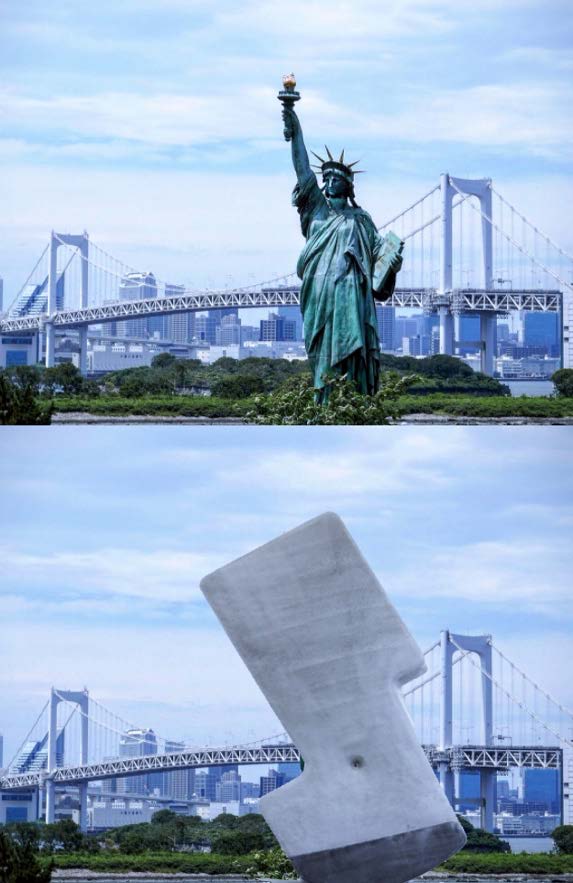
Imagine the emotional reaction of the immigrant viewing the statue of liberty from the deck of a liner, and a tourist entering the coliseum or meandering through the gardens of Versailles.
Then, imagine the visual impact of cement blocks replacing those landmarks created by the skill of some for the benefit of others.
21
Artistic heritage is our intellectual parenthood. Without it, we can only hope to be adopted by a caring family willing to provide us with the culture needed to fend off the artists of make believe.
In essence, it’s no longer about art but about humanity and its ideals.
Confronting the ongoing nonsense attests to a sincere need to generate a dialogue and elucidate an issue that goes much further than art itself. If life deserves to be experienced within our own means, some self- analysis can make us all ponder the question: “Can we be honest with ourselves?”
22
WITH THE LIBERTY TO DEFORM REALITY
COMES THE REALITY TO BE DEFORMED
23
In the twenty-first Century,
when the cyber format
becomes the oracle validating
whichever opinion it promotes,
the ability to decern the truth
belongs to each individual
capable of reading in between
the lines and find the answers
that only reason can dictate.
24